Ammonoidea
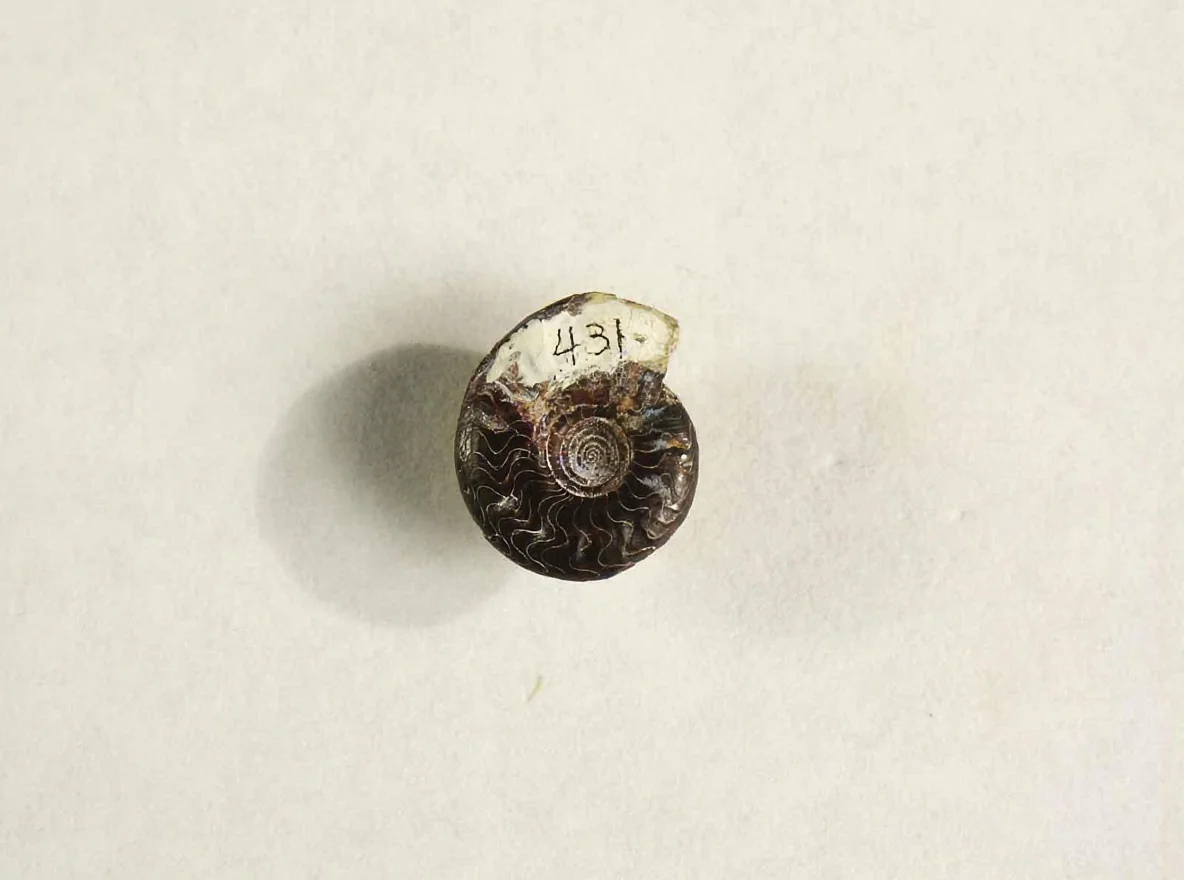
Applanoceras epichare
Ammonoidea (order and family not verified from NIMRF record)
Late Carboniferous (C3)Chenmazijing, Zhongning County, Zhongwei City, Ningxia Hui Autonomous Region, China
Classification
Ammonoidea (order and family not verified from NIMRF record)
Genus
Applanoceras
Species
epichare
Age
Late Carboniferous (C3)
Distribution
Chenmazijing, Zhongning County, Zhongwei City, Ningxia Hui Autonomous Region, China
Diagnosis
Shell small, flatly discoidal; in the juvenile stage the shell is semi-evolute, in the adult stage semi-involute, comprising about 7 whorls. Whorl cross-section semicircular to rounded-triangular, height greater than width. Venter arched and rounded. Flanks fairly wide, inclining slightly towards the venter; maximum thickness at the umbilical shoulder. Umbilicus medium-sized, about one-third of the shell diameter; umbilical wall low, inclining slightly inwards; umbilical shoulder well rounded. Shell surface ornamented with fine transverse striae, arising from the umbilical shoulder, increasing by intercalation at the middle flank, and bending backwards at the ventrolateral shoulder to form a ventral bend. On the flanks of the whorls, a shallow constriction groove occurs every 3-4 mm, running in the same direction as the transverse striae. External suture: ventral lobe fairly wide, divided into two branches by a moderately high, fairly wide median saddle; ventral branch lobe pointed tongue-shaped, siphonal lobe short tongue-shaped; lateral lobe wide, 'V'-shaped, only half the length of the ventral lobe, slightly swollen in the middle; umbilical lobe located on the umbilical wall, shallow and rounded; first lateral saddle high, its top constricted and arched-rounded. Septa dense, one suture line occurring every 1 mm.
Remarks
Illustrated specimen: Yifu Museum, China University of Geosciences (Wuhan), specimen no. X0154-03, resource no. F001000296; collected at Chenmazijing, Zhongning County, Zhongwei City, Ningxia Hui Autonomous Region, China. Age, locality and description follow the NIMRF record of the illustrated specimen; order and family are not verified from that source.