Ammonoidea
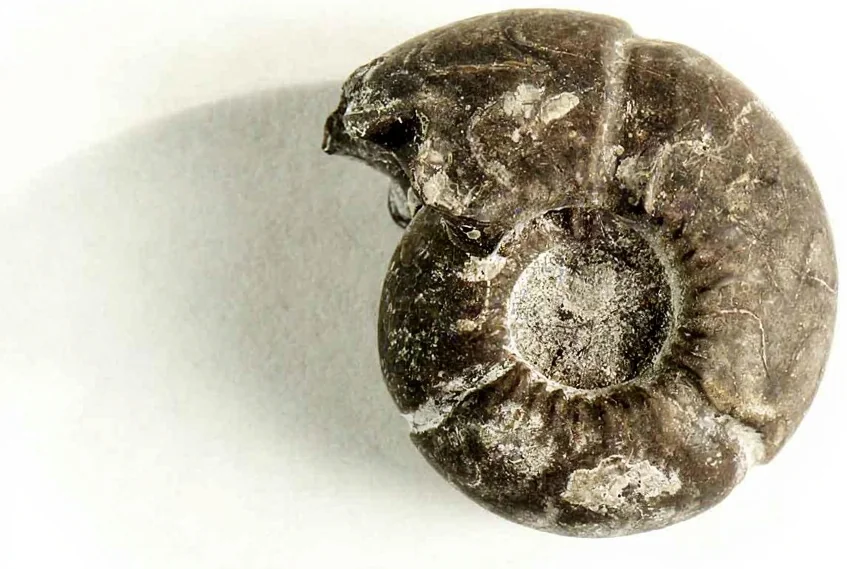
Cancelloceras zhoungweiense
Ammonoidea (order and family not verified from NIMRF record)
Late Carboniferous (C3)Xiaoyuchuan, Zhongwei City, Ningxia Hui Autonomous Region, China
Classification
Ammonoidea (order and family not verified from NIMRF record)
Genus
Cancelloceras
Species
zhoungweiense
Age
Late Carboniferous (C3)
Distribution
Xiaoyuchuan, Zhongwei City, Ningxia Hui Autonomous Region, China
Diagnosis
Shell shape and ornament change markedly during ontogeny. Small to medium specimens (shell diameter under 30 mm) are flatly discoidal, semi-involute. Whorl cross- section transversely kidney-shaped. Venter evenly rounded, flanks fairly narrow, inclined towards the venter. Umbilicus moderately large, the transverse ribs on the umbilical shoulder fine and short. Growth lines distinct, longitudinal lines weak. Three constrictions per whorl. Large shells (30-80 mm) are flatly cake-shaped, semi-involute. Whorl cross- section rounded-triangular. Venter narrowly rounded. Flanks fairly broad. Greatest thickness at the umbilical shoulder. Umbilicus small, its width 1/4 of the shell diameter, umbilical shoulder angular, umbilical wall fairly high and steep. Ribs on the umbilical shoulder gradually disappear as the shell grows; the shell is ornamented with wavy, fine longitudinal and transverse lirae, the transverse lirae forming a broad, deep ventral sinus on the venter. Constrictions disappear on the adult shell. External suture: ventral lobe broad, median saddle fairly broad, its height half that of the ventral lobe; in juveniles the lateral lobe is inverted-helmet-shaped, its outer side slightly expanded; in adults the lateral lobe is a narrow 'V' shape; first lateral saddle broad, its top fairly rounded; second lateral saddle broad, rounded and asymmetrical; umbilical lobe at the umbilical shoulder, funnel-shaped.
Remarks
Illustrated specimen: Yifu Museum, China University of Geosciences (Wuhan), specimen no. X0153-13, resource no. F001000293; collected at Xiaoyuchuan, Zhongwei City, Ningxia Hui Autonomous Region, China. Age, locality and description follow the NIMRF record of the illustrated specimen; order and family are not verified from that source.