Ammonoidea
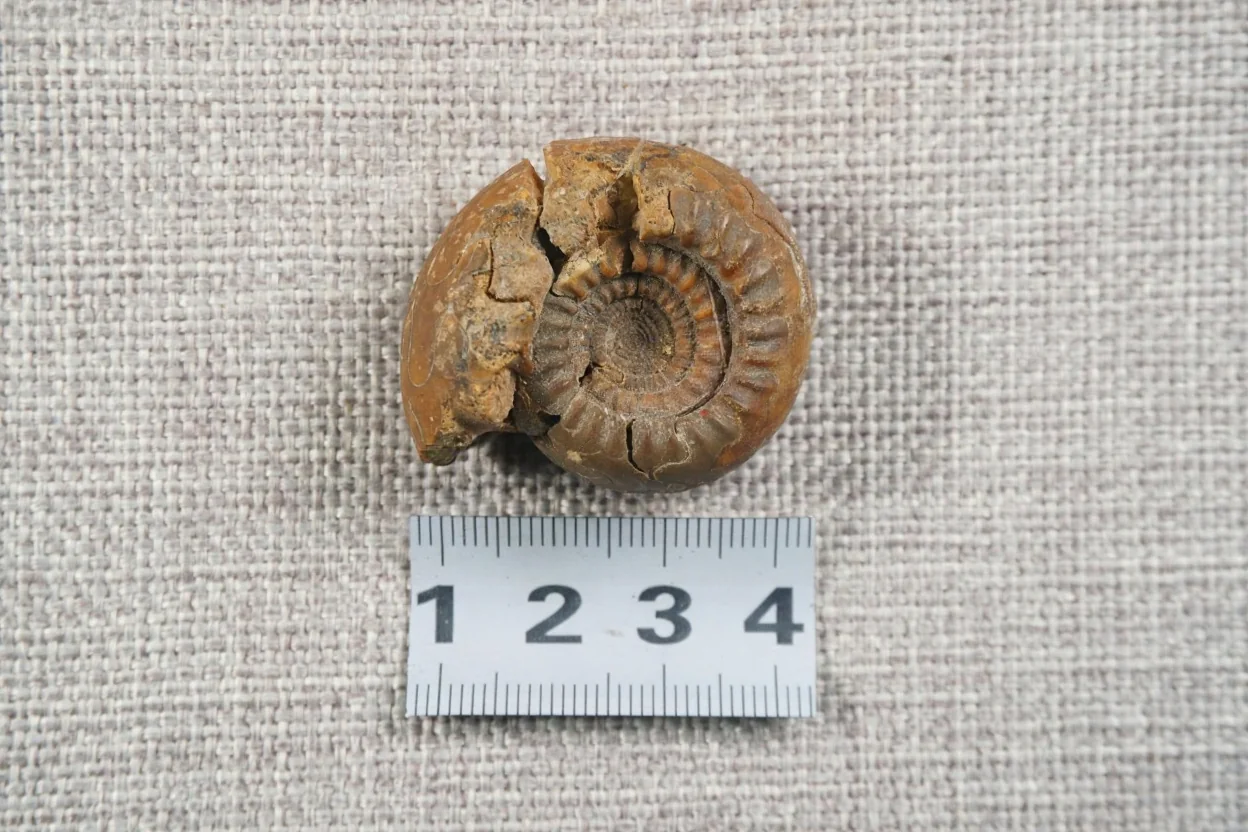
Diaboloceras shiqiantanense
Ammonoidea (order and family not verified from NIMRF record)
Late Carboniferous (C3), Pennsylvaniansouth side of Shiqiantan, Qitai County, Changji Hui Autonomous Prefecture, Xinjiang Uyghur Autonomous Region, China
Classification
Ammonoidea (order and family not verified from NIMRF record)
Genus
Diaboloceras
Species
shiqiantanense
Species author
Liang et Wang, 1991
Age
Late Carboniferous (C3), Pennsylvanian
Distribution
south side of Shiqiantan, Qitai County, Changji Hui Autonomous Prefecture, Xinjiang Uyghur Autonomous Region, China
Diagnosis
The shell is of medium size, discoidal and evolute, with 9-10 whorls; the inner 6 whorls are triangularly coiled, gradually becoming circularly coiled in the outer 3 whorls. The whorl height is less than the whorl thickness, and the whorl cross-section is nearly semicircular. The umbilicus is large and deep; the umbilical margin bears moderately coarse, short transverse ribs. The shell surface bears a reticulate ornament of interwoven transverse and longitudinal lines. In the suture drawn on the penultimate whorl, the ventral lobe is rather broad, divided by a rather high median saddle into two medium-sized ventral branches; the lateral lobe is slightly shorter than the ventral lobe, of medium width and inverted bell-shaped; the umbilical lobe lies on the umbilical wall, broad and shallow, with an incipient lobe still present on the umbilical wall. The suture drawn on the outer whorl (h = 13 mm, w = 17.5 mm) shows that with growth of the shell the lower ends of both the ventral branches and the lateral lobe become pointed; the external saddle is rather high and broadly rounded; the lateral saddle is lower, with a top that is not broad, asymmetric and inclined slightly toward the venter.
Remarks
Illustrated specimen: Nanjing Institute of Geology and Palaeontology, Chinese Academy of Sciences, specimen no. 91542, resource no. F004021174; collected at south side of Shiqiantan, Qitai County, Changji Hui Autonomous Prefecture, Xinjiang Uyghur Autonomous Region, China. Age, locality and description follow the NIMRF record of the illustrated specimen; order and family are not verified from that source.