Ammonoidea
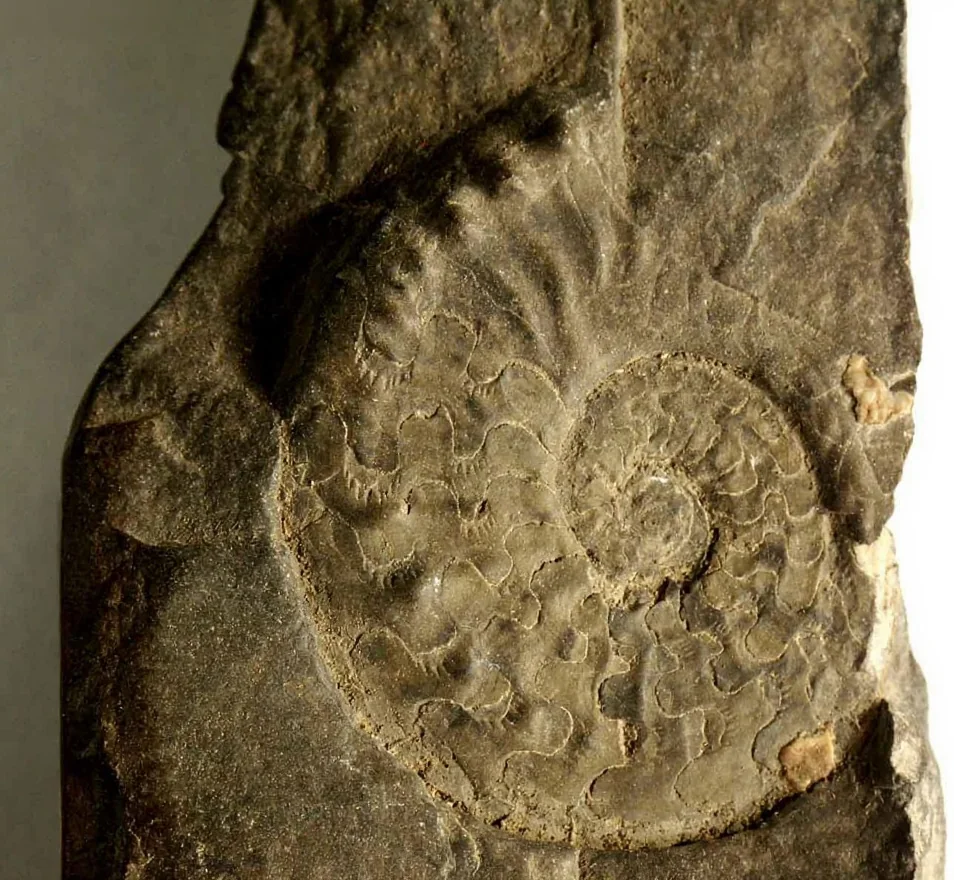
Pleuronodoceras dushanense
Ammonoidea (order and family not verified from NIMRF record)
Late Permian (P2)Penglaitan, Laibin City, Guangxi Zhuang Autonomous Region, China
Classification
Ammonoidea (order and family not verified from NIMRF record)
Genus
Pleuronodoceras
Species
dushanense
Species author
Chao et Liang
Age
Late Permian (P2)
Distribution
Penglaitan, Laibin City, Guangxi Zhuang Autonomous Region, China
Diagnosis
Shell of medium size, shell diameter about 52 mm, evolute, thinly discoidal. Whorl cross- section slightly rectangular, whorl height 22 mm, whorl thickness 13 mm, flanks strongly compressed. Venter narrow and smooth, arched and rounded, with a prominent median ventral keel. Flanks flat, umbilicus rather shallow, umbilical width 1/3 of the shell diameter, umbilical margin rather rounded, umbilical wall low. The flanks of the anterior part of the penultimate whorl bear fine dense ribs; with growth the ribs gradually become coarser, arising at the umbilical margin, thickening slightly outward, and ending at the ventrolateral margin. From the middle part of the outer whorl onward, the transverse ribs end at the ventrolateral margin in small nodes. On the anterior part of the outer whorl the transverse ribs are finer and curve slightly forward. The external suture: the ventral lobe is broad above and narrows downward, divided by the ventral saddle into two narrow pointed ventral branches, with two teeth at the lower end; the lateral lobe is rather long, its sides nearly parallel, with 7-8 teeth at the lower end; the first umbilical lobe is short, narrowing slightly downward, with 5-6 teeth at the lower end. The external saddle is the highest, narrow above and broad below; the lateral saddle is lower than the external saddle; the umbilical saddle is low and broadly rounded.
Remarks
Illustrated specimen: Yifu Museum, China University of Geosciences (Wuhan), specimen no. X0205-07, resource no. F001000341; collected at Penglaitan, Laibin City, Guangxi Zhuang Autonomous Region, China. Age, locality and description follow the NIMRF record of the illustrated specimen; order and family are not verified from that source.