Ammonoidea
Tapashanites costatus
Ammonoidea (order and family not verified from NIMRF record)
Late Permian (P2)Xindianzi, Shahe Town, Chaotian District, Guangyuan City, Sichuan Province, China
Classification
Ammonoidea (order and family not verified from NIMRF record)
Genus
Tapashanites
Species
costatus
Species author
Zhao, Liang et Zheng
Age
Late Permian (P2)
Distribution
Xindianzi, Shahe Town, Chaotian District, Guangyuan City, Sichuan Province, China
Diagnosis
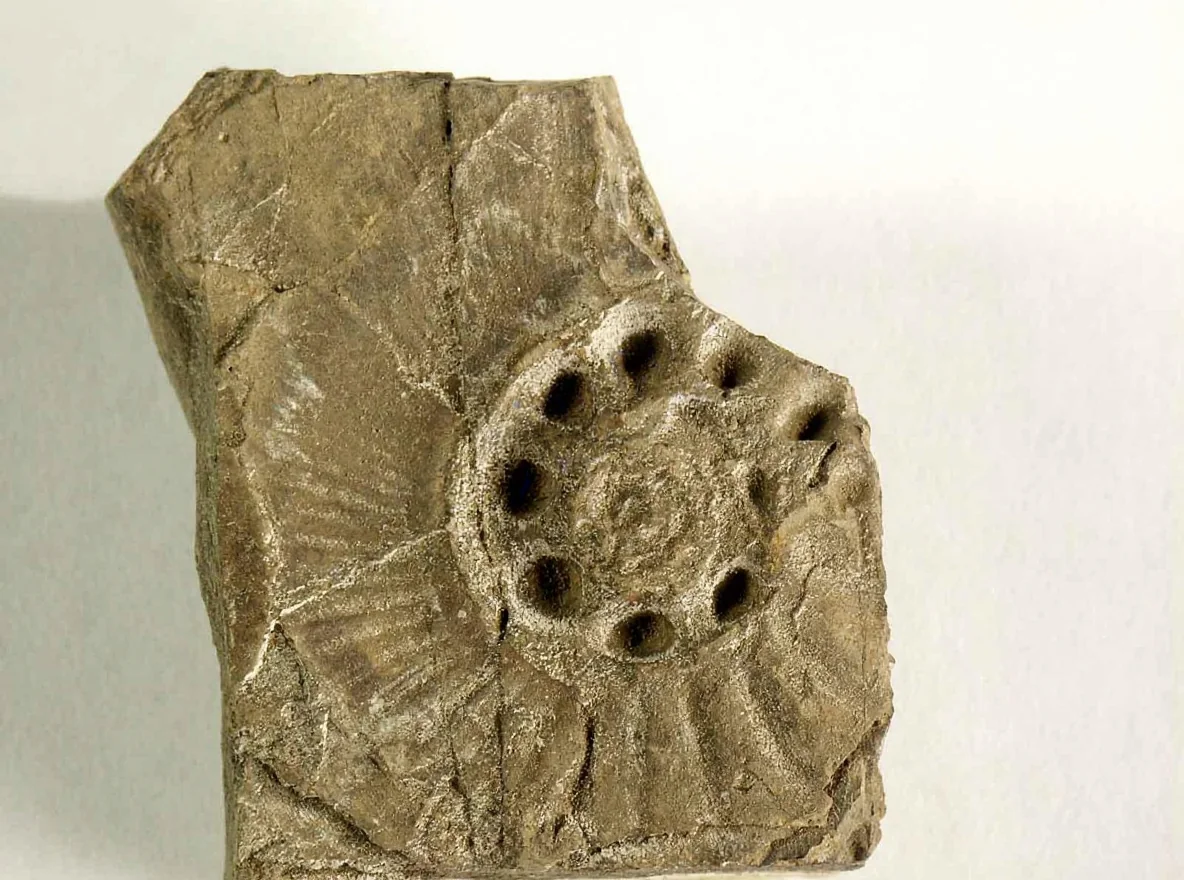
Shell fairly large, evolute, discoidal; outer whorl cross-section semi-elliptical, height greater than thickness. Venter smooth, fairly narrow, evenly rounded. Ventrolateral parts rounded, flanks slightly convex. Umbilicus shallow, umbilical width almost half the shell diameter, umbilical shoulder fairly rounded, umbilical wall low and steep. Body chamber more than half a whorl long. Inner whorls narrow on the flanks, with small nodose ribs; as the whorl grows the ribs gradually thicken, becoming very coarse radial transverse ribs by the penultimate whorl; the ribs weaken outward from the umbilical shoulder and disappear on the ventrolateral parts; on the outermost whorl they become fine transverse ribs inclined forward, extending backward obliquely from the umbilical seam, turning forward at the middle of the umbilical wall and gradually thickening, becoming straight and coarse on the inner flank, then weakening and finally disappearing on the ventrolateral parts, curving slightly forward. Suture: ventral lobe broad and short; lateral lobe long, its sides nearly parallel, lower end with 7-8 denticles; first umbilical lobe narrow and short, lower end with 3-4 denticles. Median saddle broad and low; external and lateral saddles with nearly parallel sides, their widths and heights nearly equal.
Remarks
Illustrated specimen: Yifu Museum, China University of Geosciences (Wuhan), specimen no. X0204-01, resource no. F001000329; collected at Xindianzi, Shahe Town, Chaotian District, Guangyuan City, Sichuan Province, China. Age, locality and description follow the NIMRF record of the illustrated specimen; order and family are not verified from that source.