Salamandridae (incertae familiae)
Beiyanerpeton jianpingensis Gao et Shubin, 2012
Salamandridae (incertae familiae)
Late JurassicLiaoning, China
Family
Salamandridae (incertae familiae)
Genus
Beiyanerpeton
Authority
Gao et Shubin, 2012
Original combination
Beiyanerpeton jianpingensis
Age
Late Jurassic
Locality
Liaoning, China
Diagnosis
Diagnostic features A Late Jurassic paedomorphic Salamandroidea member, with the following unique character combination: skull broader than long, with anterodorsal fenestra and anteromedial fenestra; premaxilla and maxilla outer surfaces with sensory grooves; prefrontal and lacrimal present; palatine separate and dentate; marginal teeth nonpedicellate, simple钉-shaped and significantly shorter than vomerine teeth; parasphenoid posterolateral wings with groove for internal carotid artery; operculum separate from columella; first and second hypobranchials ossified; first and second basibranchials fused; angular lost, fused with prearticular; 15 presacral vertebrae; vertebrae shortened, strongly constricted, with distinct subcentral keel; digital formula 2-2-3-2/3, pedal formula 2-2-3-4-3.
Remarks
Remark Near completion of this book, Gao Keqin and Shubin named Beiyanerpeton, a new genus assigned to Salamandroidea incertae familiae. The genus name derives from 'Beiyan,' the name of the fossil locality during China's 'Sixteen Kingdoms' period. Gao and Shubin (2012), through phylogenetic analysis, considered Beiyanerpeton the most basal member of Salamandroidea, and inferred that the divergence of the two major urodelan suborders (Cryptobranchia and Salamandroidea) predates the Late Jurassic (possibly Middle Jurassic), with divergence occurring on Eurasia.
Remark Gao and Shubin (2012) established B. jianpingensis based on 6 numbered specimens (PKU PV 0601-0606) and several unnumbered specimens; species name from fossil locality Jianping County. One numbered specimen (PKU PV 0601) designated as holotype, others listed as referred specimens. However, according to ICZN Article 72.4.5, these referred specimens published in the same paper should also belong to the type series, and specimens other than the holotype should be paratypes. paratype. Therefore, this book changes these specimens from referred specimens to paratypes.
Remark Yang Zhongjian (1979b), when describing a new dinosaur footprint from Luanping County, Hebei,
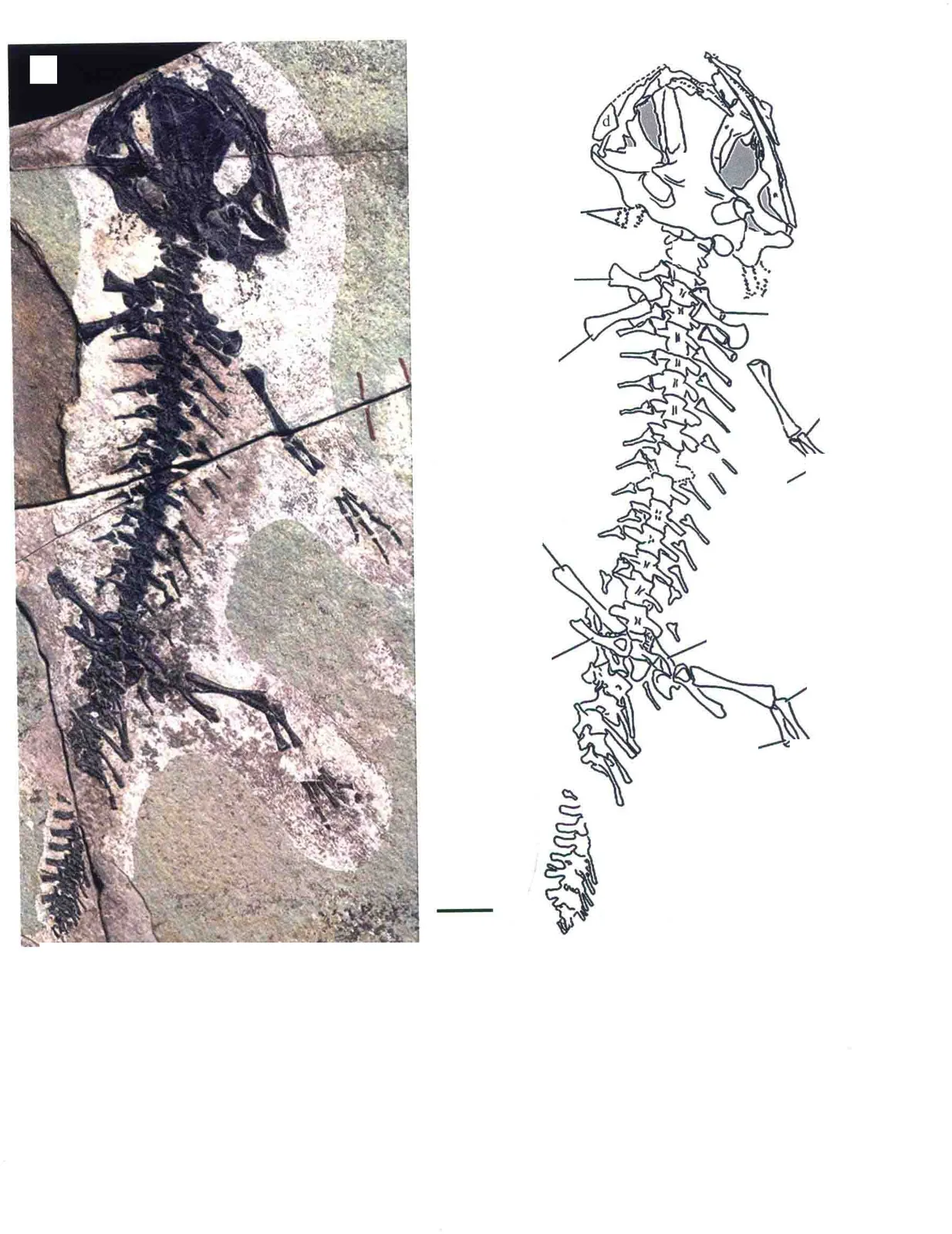
Figure caption
Holotype of Beiyanerpeton jianpingensis (PKU PV 0601) (from Gao et Shubin, 2012)