Salamandridae
Procynops? miocenicus Young, 1965
Salamandridae
MioceneShandong, China
Family
Salamandridae
Genus
Procynops?
Authority
Young, 1965
Original combination
Procynops? miocenicus
Age
Miocene
Locality
Shandong, China
Diagnosis
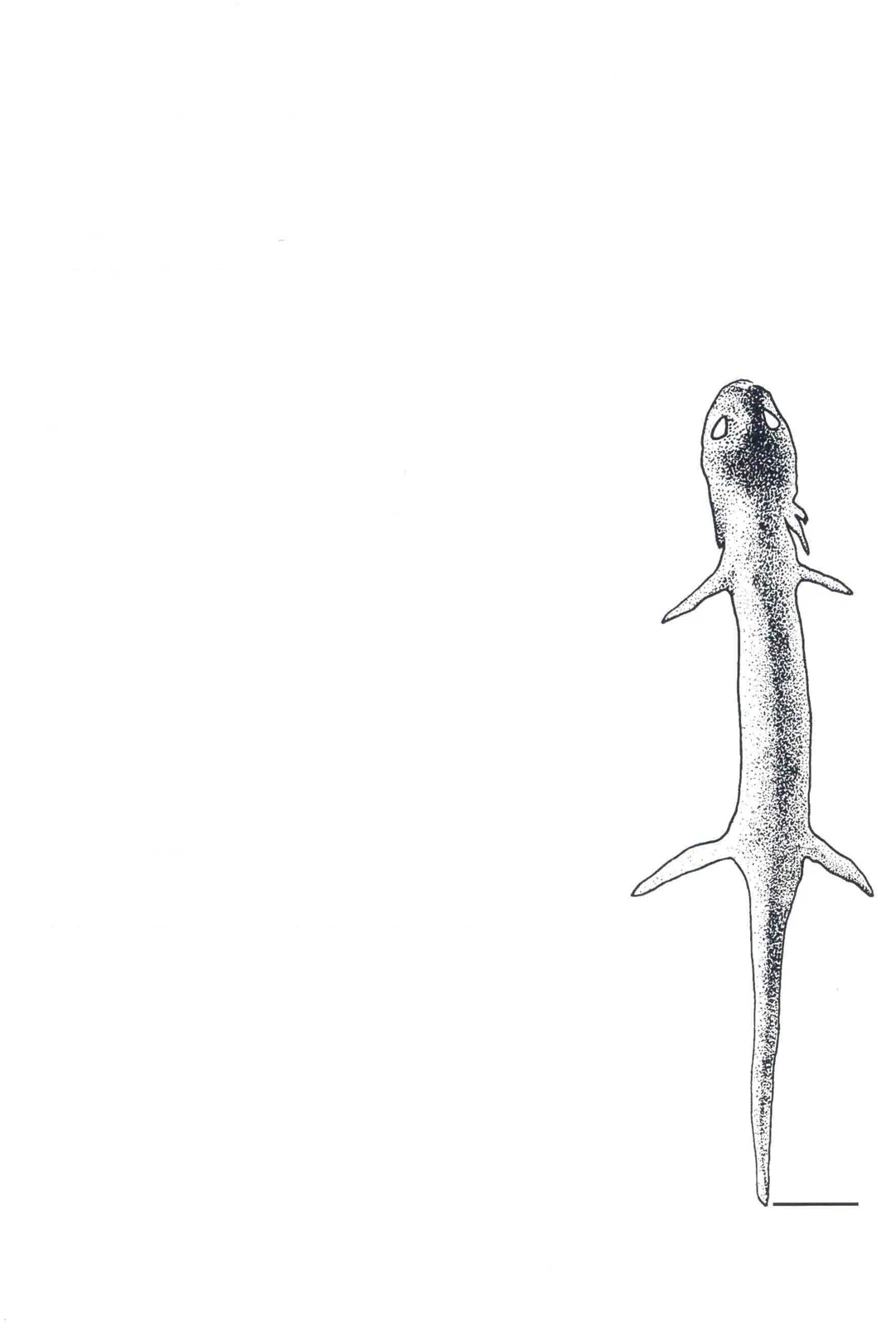
Diagnostic features Small body, slender weak limbs; tail length less than half total length; body may have uniformly fine tubercular spots, but no large dorsolateral or lateral spots. Head size and shape very similar to Cynops orientalis, but body length approximately one-quarter to one-third smaller, the smallest known Cynops species (Yang Zhongjian, 1965).
Estes (1981) provided a completely different set of diagnostic features, but apparently more effective: distinguished from extant Cynops species by nares more dorsally positioned (if specimen not deformed), lacking sagittal tubercle, and body length smaller than extant species. Additionally, Estes (1981) noted this genus is clearly closely related to Cynops, but at higher latitude habitat (400 km north of Cynops orientalis).
Diagnostic features same as genus.
Remark Yang Zhongjian (1965) provided original data showing the holotype has preserved length 43.3 mm, two paratypes 47 mm and 48 mm, estimated total length 47-49 mm, thus smaller than Cynops orientalis; also described as 'skull outline a fairly clear pentagon,' 'nares with slight distance from anterior margin, not as close to anterior edge as modern species,' 'skin impressions also different... dorsal ridge structure not observed.' Because the naming author did not provide other sufficient diagnostic features, whether this genus is valid remains questionable.
Diagnostic features Usually with distinct dorsal crest.
Remarks
Remark This genus represents China's first discovered urodelan fossil. However, its establishment basis is questionable; see remarks on the species below.
Remark Yang Zhongjian (1965) provided original data showing the holotype has preserved length 43.3 mm, two paratypes 47 mm and 48 mm, estimated total length 47-49 mm, thus smaller than Cynops orientalis; also described as 'skull outline a fairly clear pentagon,' 'nares with slight distance from anterior margin, not as close to anterior edge as modern species,' 'skin impressions also different... dorsal ridge structure not observed.' Because the naming author did not provide other sufficient diagnostic features, whether this genus is valid remains questionable.
Figure caption
Holotype of Procynops? miocenicus [(BMNH PV128)]