Hynobiidae
Sinerpeton? fengshanensis Gao et Shubin, 2001
Hynobiidae
Early CretaceousHebei, China
Family
Hynobiidae
Genus
Sinerpeton?
Authority
Gao et Shubin, 2001
Original combination
Sinerpeton? fengshanensis
Age
Early Cretaceous
Locality
Hebei, China
Diagnosis
metacarpal greatly expanded; digital formula 1-2-3-2, pedal formula 1-2-3-4-2.
Known Chinese species only the type species.
Known Chinese species Only the type species.
Distribution and age Hebei; Early Cretaceous.
Remark Sinerpeton and Laccotriton come from the same locality, same horizon, and same fossil excavation pit, with many skeletal features similar. Whether this genus is a synonym of the latter is worth exploring. See remarks on the species below.
Sinerpeton? fengshanensis Gao et Shubin, 2001
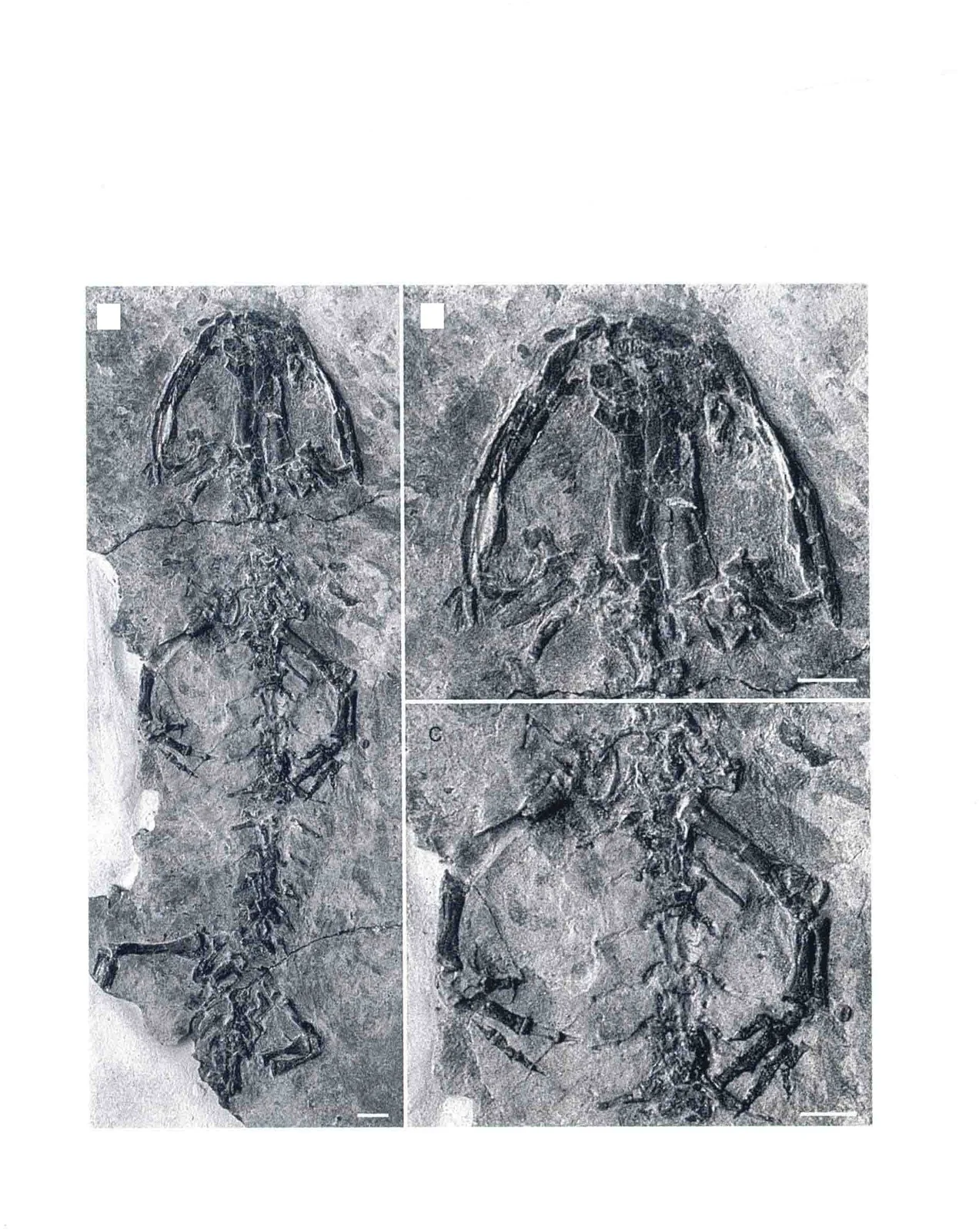
Holotype (GMC) GMV1606, an incomplete articulated skeleton. From Paozhanggou, Fengshan, Fengning, Chengde, Hebei.
Fig. 53 Sinerpeton? fengshanensis holotype [(GMC) GMV 1606] (dorsal view)
(from Gao et Shubin, 2001)
A. Associated skull and postcranial skeleton; B. Enlarged skull; C. Enlarged pectoral girdle and forelimb. Scale bar 2 mm
Remarks
Remark Sinerpeton and Laccotriton come from the same locality, same horizon, and same fossil excavation pit, with many skeletal features similar. Whether this genus is a synonym of the latter is worth exploring. See remarks on the species below.
Remark All specimens of this genus and species come from the same locality and horizon as Laccotriton subsolanus, but Gao and Shubin (2001) considered Sinerpeton fengshanensis as a paedomorphic form, distinguishing it from metamorphosed Laccotriton subsolanus. However, Wang (2006) pointed out Sinerpeton's slender ceratobranchial cannot support external gills; this ceratobranchial is likely the first pair, common in metamorphosed urodels, so whether Sinerpeton is paedomorphic remains questionable. Additionally, S. fengshanensis holotype is very similar to Liaoxitriton zhongjiani juvenile skeletal features, so whether the former is a junior synonym of the latter requires further research. Accordingly, Wang et al. (2008) added a question mark '?' to Sinerpeton. This book also tentatively adopts this approach.
Remark According to Martin and Sanchiz (2012), Salamandridae has 26 extant or fossil genera with fossil representatives, with Triturus having the greatest diversity. This family's earliest reliable fossil record appears in the Paleocene, but Salamandroidea members can be traced to Valdotriton from the Early Cretaceous of Spain (Evans and Milner, 1996). At the completion of this book, Gao and Shubin (2012) reported the earliest known Salamandroidea representative,
Figure caption
Holotype of Sinerpeton? fengshanensis [(GMC) GMV 1606] (dorsal view)