Hynobiidae
Liaoxitriton zhongjiani Dong et Wang, 1998
Hynobiidae
Early CretaceousLiaoning, China
Family
Hynobiidae
Genus
Liaoxitriton
Authority
Dong et Wang, 1998
Original combination
Liaoxitriton zhongjiani
Age
Early Cretaceous
Locality
Liaoning, China
Diagnosis
Diagnostic features Distinguished from L. daohugouensis by: snout tip narrower; vomerine tooth row extending posterolaterally; prearticular coronoid flange low; scapulocoracoid coracoid end smaller, scapular shaft longer; 15 presacral vertebrae; second presacral rib distal end棒状 without expansion; 2 pairs postsacral ribs; second metacarpal expanded; digital formula 2-2-3-(2/3), pedal formula variable, observed types include 2-2-4-5-(3/4), 2-2-3-4-(2/3), ?-3-4-5-3, or 2-2-3-5-4.
Remarks
Remark Liaoxitriton was established by Dong Zhiming and Wang Yuan (1998) based on 34 specimens from Huludao, Liaoning, named after its location in western Liaoning; over the following decade, hundreds more specimens were found at this locality. These specimens' locality was once mistakenly identified as 'Shajiaocheng, Huludao' (Dong Zhiming, Wang Yuan, 1998). Wang (2001) revised the locality to 'Wangbao, Huludao' (likely a misspelling of 'Wangbaoshan, Huludao'). Wang Yuan (2002), based on field surveys, finally identified the locality as 'Shuikouzi Village, Wangbaoshan Brigade, Xintaimen Town, Huludao.' Regarding the fossil horizon correlation, different opinions exist. Dong Zhiming and Wang Yuan (1998) considered it the Lower Cretaceous Jiufotang Formation; Wang Yuan (2002), based on amygdaloidal basalt exposures in the region, considered the Yixian Formation possibility cannot be excluded. Wang Sien identified conchostracan specimens collected by Wang Yuan from the same Liaoxitriton horizon as Eosestheria sp. and Eosestheria cf. middendorfii, correlating the strata to the Yixian Formation or basal Jiufotang Formation. Zhang Lijun et al. (2004) reported a second Liaoxitriton-bearing horizon in this area, with Ephemeropsis trisetalis, Eosestheria ovata, Liaoningogladus boii, Sphenaron sp., Ephedrites? sp., etc., and based on the co-occurrence of Eosestheria ovata and Liaoningogladus boii, concluded the horizon should be Yixian Formation, not Jiufotang Formation. Ephedrites? sp.) and other associated plants and animals, and based on Eosestheria ovata with Liaoningogladus boii appearing together, considered the fossiliferous horizon to be Yixian Formation rather than Jiufotang Formation. Zhang Lijun et al.'s Liaoxitriton horizon (measured section layers 4-6) is lower than that reported by Dong Zhiming and Wang Yuan (1998) (measured section layer 24); the paper treated both Liaoxitriton-bearing sedimentary interbeds in the section as shallow lacustrine deposits during
Figure caption
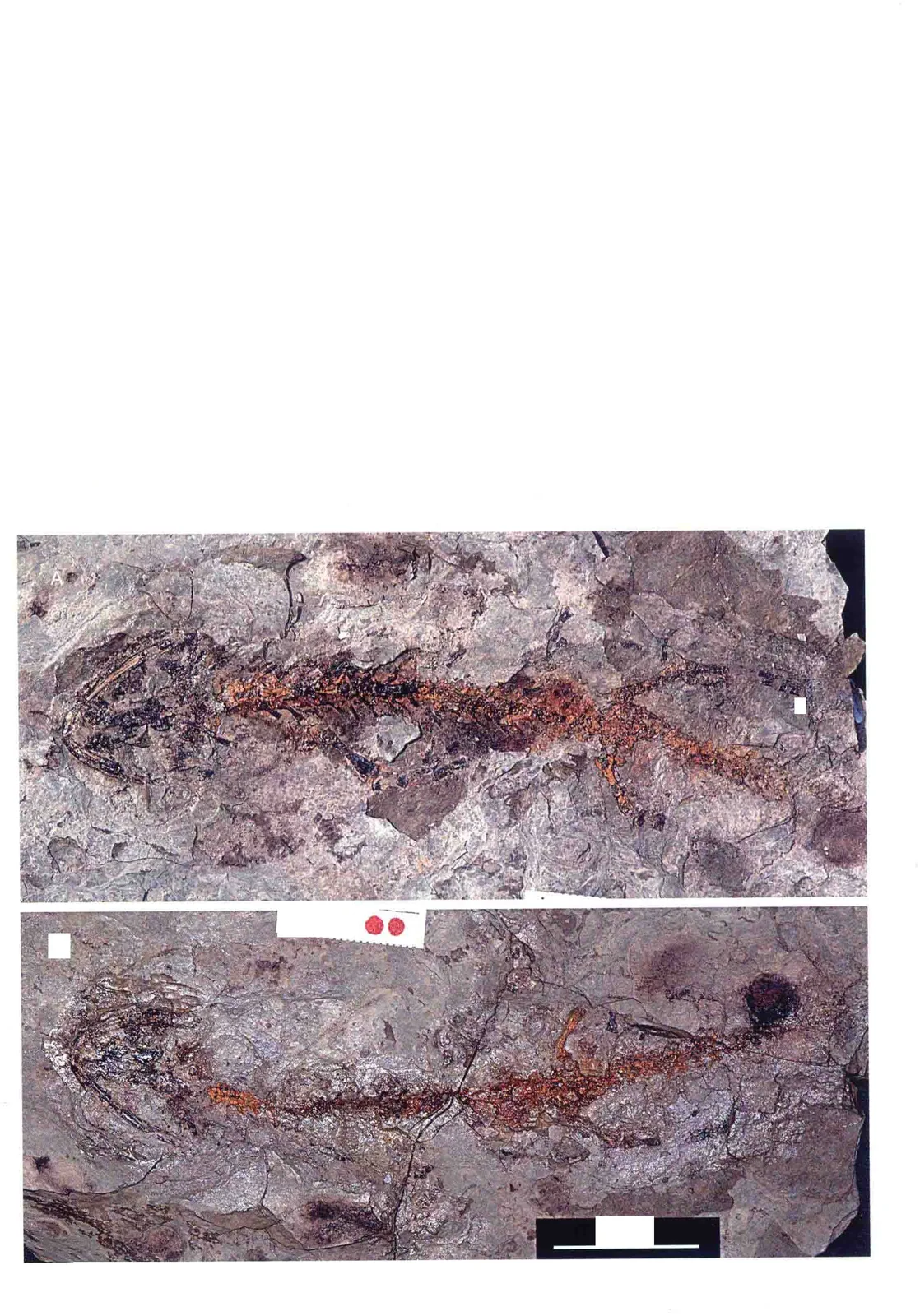
Holotype of Liaoxitriton zhongjiani (IVPP V11582), ventral (A) and counterpart views